Diploid or pseudohaploid calls for your whole genome
Which genotype calls to choose when you add a BAM or CRAM: diploid for a 30x genome, pseudohaploid for low-pass, and the options for ancient DNA libraries.
Updated 2 min read
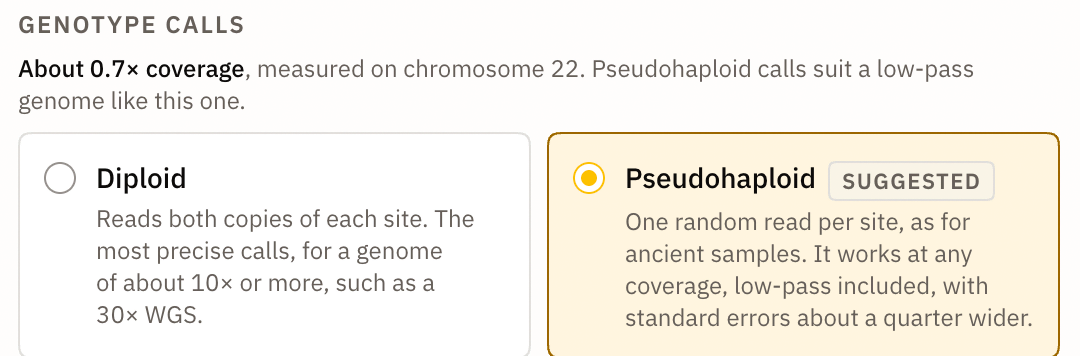
Choose diploid calls for a genome of about 10x or more, and pseudohaploid calls for anything thinner. When you add a BAM or CRAM, Nexju measures your coverage on chromosome 22 and marks the calls that suit it, so in most cases you keep what it suggests.
Read Add your whole genome for the whole upload, step by step.
Diploid calls
A diploid call reads both copies of each site, so it can tell a heterozygous site (one copy of each allele) from a homozygous one. That needs several reads at each site, which is why diploid calls suit a genome of about 10x or more, such as a standard 30x WGS.
Diploid calls are the most precise. In a qpAdm model, your standard errors are the smallest a single genome can give.
Pseudohaploid calls
A pseudohaploid call picks one read at random at each site and keeps its allele. It needs only one read, so it works at any coverage, a 0.5x low-pass genome included.
Most ancient genomes in the Allen Ancient DNA Resource are called this way, because they are thin too. Calling your genome the same way treats you and the ancient samples alike. Your standard errors come out about a quarter wider than with diploid calls, since each site carries half the information.
What the coverage check shows
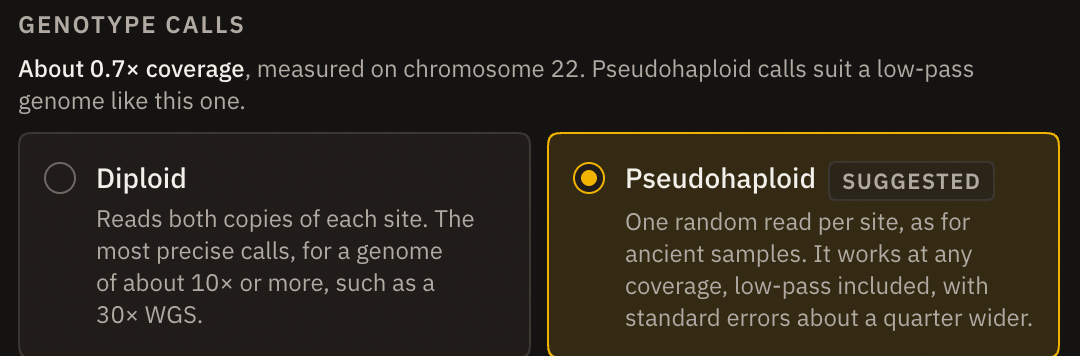
When both files are in, a line above the choices gives your coverage and which calls suit it. A low-pass genome gets Pseudohaploid marked as suggested.
If you choose Diploid for a genome that is too thin, the line turns into a warning. At 0.7x, most sites would have too few reads for a diploid call and would stay uncalled.
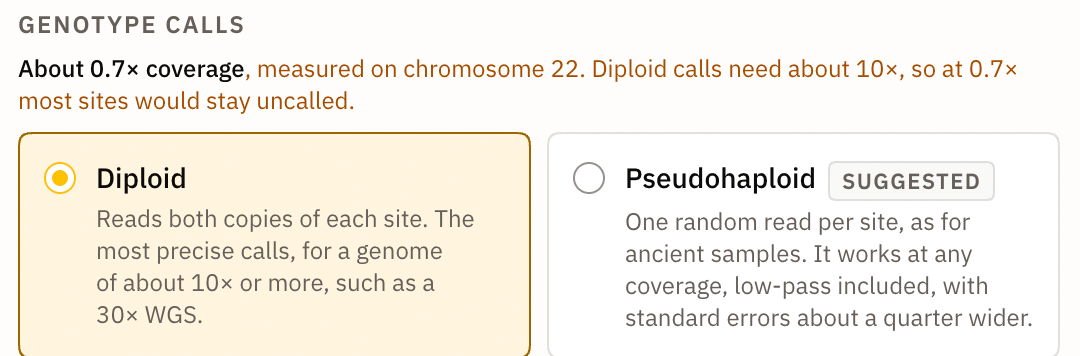
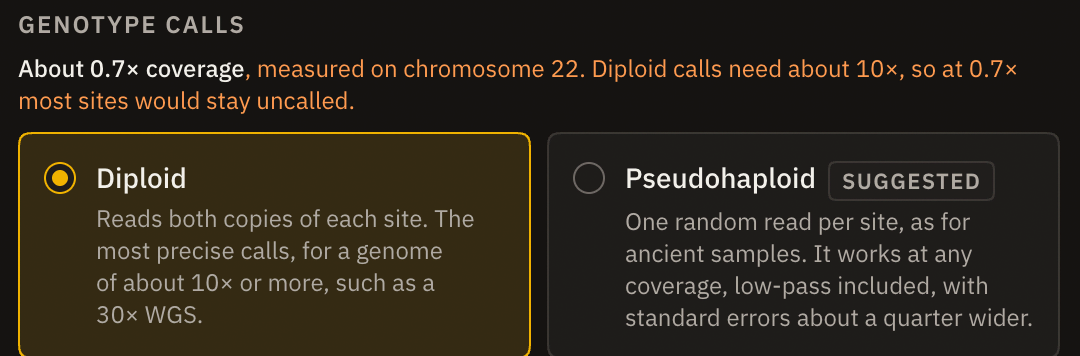
You can still go ahead, but you will lose most of your sites. If too few sites are called, the genome fails, and you add it again with pseudohaploid calls.
Calls for ancient DNA libraries
Under Options for ancient DNA libraries there are two more pseudohaploid calls. They are for genomes sequenced from ancient bone, not for a modern genome from a sequencing company.
Pseudohaploid, transversions only is for a library that was not UDG-treated. Ancient DNA damage turns C into T and G into A, which looks like a mutation, so these calls skip every C/T and G/A site. You keep fewer SNPs, but none of them is damage.
Pseudohaploid, single-stranded is for a single-stranded library. It reads C/T sites from reverse reads only and G/A sites from forward reads only, where damage cannot show.
Changing the calls later
The calls are made once, when your browser reads the file. To use other calls, add the genome again with the calls you want, and delete the copy you no longer need. Each copy counts as one of your plan's DNA uploads while you keep it.